Chinese Army Chess vs AI
Look Once Before You Flip
This is two-player Chinese Army Chess, also called Junqi or Luzhanqi. The board is 5×12, with 25 pieces on each side. Pieces start face down, and carrying off the flag wins. Si Guo Jun Qi seats four players on a different board. A costly move usually comes from flipping or stepping onto a square before you have checked whether the opponent can reach your flag on the next turn, whether that square is a mine, and whether the move gives up a bomb. Play against multiple AI levels, share one screen, or open a room and play a real person. No account is required, and you can start before every rank is memorized. Before you flip or move, look at the flag, then at the square, then at what the move reveals.
Pick the Way You Want to Play
Play a real person when you can. Wait in the public lobby, or create a room and send the link. Share one screen when someone is beside you. Use the AI when you are playing alone.
Check These Three Things Before You Flip or Move
First, look at the flag. Can the opponent reach it on the next turn? The flag and the mines cannot move on their own. If you move the piece that stands in front of the flag, the opponent can end the game. When the flag is already one move from capture, do not pursue another capture.
Second, look at the square. A face-down piece hides its rank. Before you move onto it, ask whether it might be a mine, and whether your piece is an engineer. If a piece of high rank is already revealed, ask whether the opponent has a bomb that can reach it along the railway.
Third, look at what the move reveals. A flag or a mine stays on the square where you flip it, so the opponent learns its position. Flip a commander or a bomb on a railway square, and the opponent can exchange for it on the next turn. Many lost games begin with a flip that should have stayed face down.
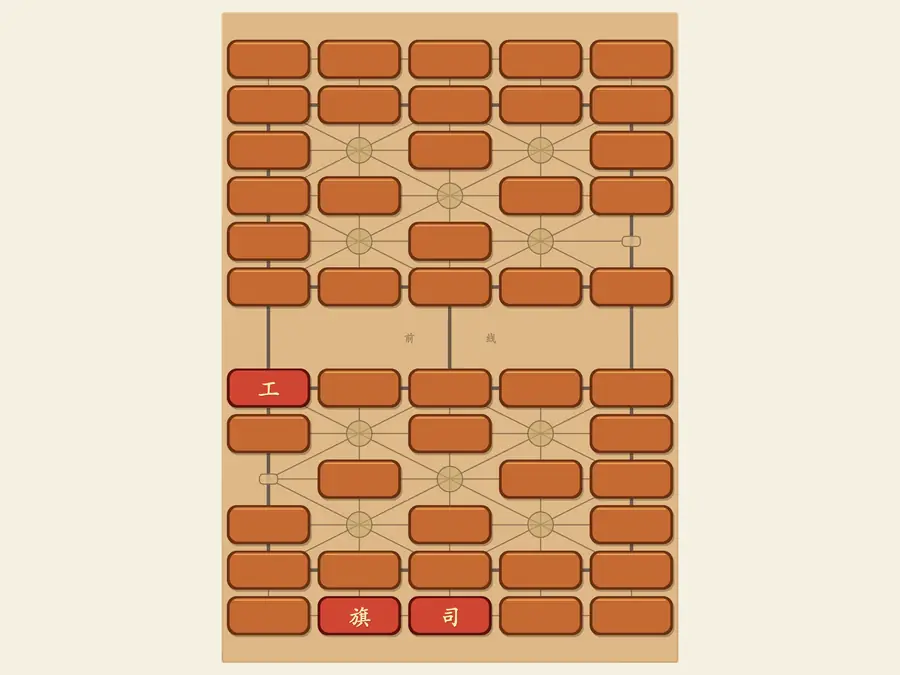
A Revealed Piece Depends on Its Square
A commander far from the railway cannot reach the front for some time. An engineer already on the railway can turn toward the opponent's headquarters. Judge the piece by whether it can move along the railway, and by whether another piece blocks that line, not by rank alone. A move that places a piece on the railway, and still leaves a piece beside the flag, is more useful than flipping a piece in the rear.
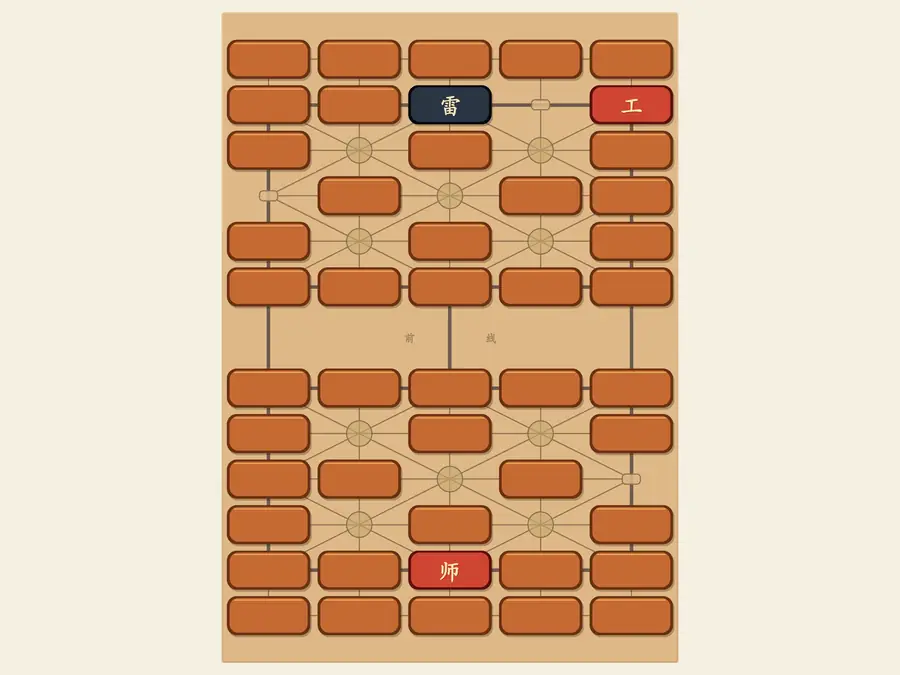
A Revealed Mine Calls for an Engineer
When an engineer moves onto a mine, the mine is removed and the engineer stays. Any other piece is removed with the mine. When a mine is revealed, look for an engineer. Do not test it with a field marshal or a general. An engineer may turn at a railway crossing. Other pieces on the railway move in a straight line. Until a mine is revealed, keep an engineer where it can return toward your flag.
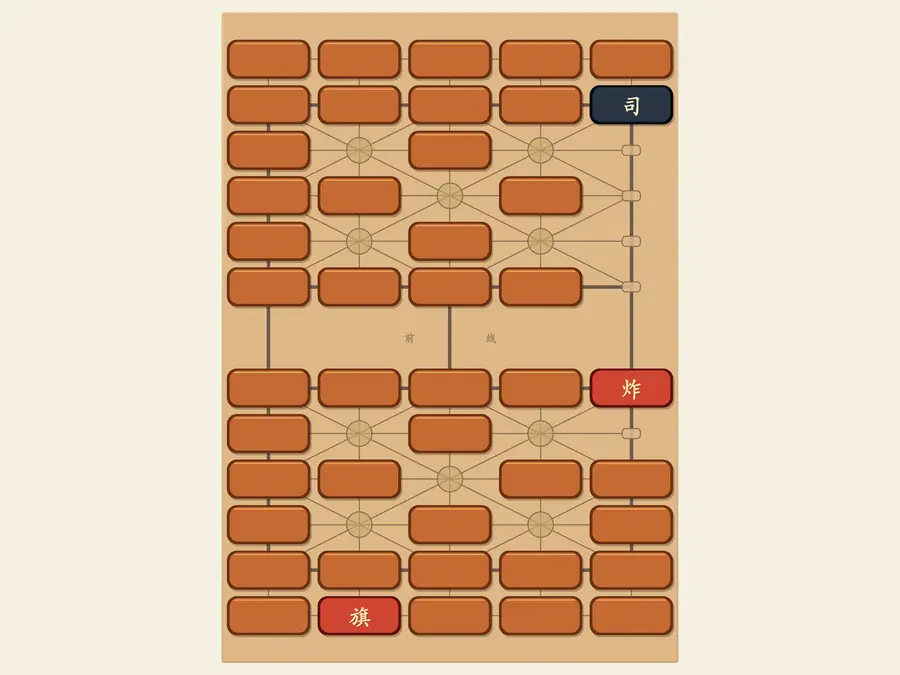
A Bomb Exchange Is Not Only the Piece Removed
A bomb is not ranked. It is removed together with a commander, a field marshal, or another bomb. A bomb that reaches a revealed flag wins. Before you use one, see whether the piece you remove is already revealed and of high rank, whether a piece will still guard the flag, and whether the opponent can reach the flag on the next turn. Removing a low-ranking piece and leaving the flag unguarded is a poor exchange.
Common Questions
Does this site play standard Chinese Army Chess, and where does it differ?
Capture and the flag follow the usual rules. A higher rank takes a lower one, equal ranks remove both, only an engineer removes a mine and stays, a bomb is removed with any other movable piece, and moving onto the flag wins. Three points differ from refereed standard play. Every piece starts face down, and a flip or a move is settled at once, with no referee declaring the capture. A piece may leave headquarters after entering it. When the commander is captured, the flag is not revealed. It stays face down until a player flips it or moves onto that square.
Are games against the AI uploaded to a server?
No. Games against the AI, and games on one screen, stay in this browser. Moves are sent to a room only when you play online, so the two boards can stay in sync. The types of pieces that are still face down stay in the room and are not sent to the other player.
How do I use hints, undo, and replay without just copying the answer?
Decide whether to flip or to move a revealed piece, then open the hint. If the hint differs, check the flag, any mine, and any bomb on the railway. Undo returns the position to that move, so you can try the other choice. In replay, begin at the first move where the position clearly worsened, rather than at the loss of the flag. The hint uses the strength selected in the sidebar.
Can I play without an account or a download?
Yes. Open the page on a phone, tablet, or computer. There is no account to create and no app to install. Practice against the AI on this page, take turns with someone beside you, or create a room and send the link.
Do hints and undo work the same way on one screen and online?
No. Against the AI you can use a hint, undo, and replay. On one screen you can undo and replay, but there is no hint. In an online room you cannot undo on your own, and there is no hint. Once the room accepts a move, it is sent to the other player, so check the flag, the mines, and the railway before you move.
Are the AI strengths a real rank, and how should I choose one?
The sidebar offers several strengths, and you can play Red or Blue. Gentle practice misses obvious moves, which is useful while you learn to flip and to move. Beginner opponent is the default when the page opens. Advanced practice makes fewer mistakes. A strength changes only how carefully the AI replies. It is not a formal rank, and the site keeps no rating.
If I refresh the page or switch devices, is the game still there?
Games against the AI, and games on one screen, remain in the browser you are using, so a refresh usually continues the same game. Red and Blue are stored separately, and so are the dark and flip setups. The game does not appear on another phone or computer. Clearing this site's data removes it, and there is no account that can restore it. An online room keeps the boards synchronized only for a time. It does not keep a permanent record.
If I drop offline in the middle of an online game, does that game still count?
Leaving the room returns you to the lobby. Your seat and the game remain, and the same link brings you back. Moves the room has already accepted stay on the board if the connection drops. If both players leave and the room is idle for about 20 minutes, it expires. The host can also close it, and the previous link then no longer opens the room.
Is this Junqi, Luzhanqi, or the four-player game?
Junqi and Luzhanqi are names for the same two-player game, Chinese Army Chess. The board is 5 by 12, each side has 25 pieces, and every piece starts face down. Carrying off the opponent's flag wins. This page plays that game. Four-player Army Chess, Si Guo Jun Qi, puts one player on each side of a different board. This site seats two.
What is the difference between Dark and Flip, and which should I open with?
In Dark, each side places its 25 pieces on its own half, and the camps start empty. The flag is in one of the two headquarters, mines are in the back two rows, and bombs stay off the rank nearest the opponent. Flip mixes all 50 pieces across the board, so those limits do not apply and a face-down square shows nothing. Against the AI, or on one screen, the sidebar switches between Dark and Flip. An online room opens a Dark game once both seats are taken. While the board is still new, start with Dark. The back rows and the front rank are easier to read.